ePatient Dave offered this marvelous talk at TEDx Maastricht. The whole thing is worth watching, but you can see the highlights starting at minute 13:08.
Are you watching, JAMA?
If you cannot see the video, click here.
Tuesday, April 12, 2011

Monday, April 11, 2011
JAMA hides its review of Overdiagnosed
I wonder if the people at JAMA are ever going to understand that the journal would have even more influence if they made articles of a general nature free and available for all to read. Especially when the article makes a recommendation to the general public.
Here is one example, a thoughtful book review in the April 6 edition written by Dr. Leonard Berlin. The topic is Overdiagnosed: Making People Sick in Pursuit of Health, by H. Gilbert Welch, Lisa M. Schwartz, and Steven Woloshin.
Here is the part of the review that JAMA lets you see:
A little-noticed but nonetheless profound evolution in medical practice took place in the latter half of the 20th century. Until that time, individuals visited their physicians only when they experienced symptoms and worried they were ill. Now they began to visit their physicians to undergo testing to detect occult disease, even if they felt healthy and were asymptomatic. A new mantra worked its way into medicine in the United States and was quickly adopted by the public: get tested, diagnose disease early, and be treated while the problem is “small” before it becomes “big” or, even better, before a potential disease becomes a reality. This was, and still is, the right thing to do—correct? Well, maybe not, claim [the authors]. Such testing of healthy individuals all too often results in overdiagnosis and overtreatment, because in reality there is “nothing to fix.”
The next sentences are: As a result, contend the authors, although a few will be helped, many will be overdiagnosed, and some will be harmed. This theme permeates the book.
This is very important stuff. A scientist friend reminds me that, as a general matter, the predictive value of a screening test is mathematically related to the prevalence of the disease in the screened population; so the less prevalent, the tougher it is to have a high predictive value.
You can get a good sense of the book itself from these excerpts published in the New York Times. (Hey JAMA, please note: They include way more than 150 words!) But, let me give you some more excerpts from the book review:
That the prevalence of overdiagnosis has reached epidemic proportions, according to the authors, is attributable to the changing guidelines regarding numerical values of what is considered normal and abnormal as well as to technological advances in radiologic imaging.
According to data documented in the book incidentalomas are found in the lungs of 50% of otherwise “healthy” persons undergoing computed tomography of the chest; in the kidneys and livers of 23% and 15%, respectively, of those undergoing computed tomography of the abdomen; and in the thyroid glands of 67% of those undergoing ultrasound examinations of the neck. The chance that the incidentaloma could represent a lethal cancer is considerably less than 1%.
In all of these areas, the authors argue that the quest to find potential disease which may not exist or, if it does, will never harm the patient often leads to unnecessary surgery and medication that may cause serious adverse effects as well as patient anxiety and ever-increasing costs.
And the important conclusion:
Overdiagnosed is a provocative, intellectually stimulating work. As such, all who are involved in health care, including physicians, allied health professionals, and all current or future patients, will be well served by reading and giving serious thought to the material presented.
Here is one example, a thoughtful book review in the April 6 edition written by Dr. Leonard Berlin. The topic is Overdiagnosed: Making People Sick in Pursuit of Health, by H. Gilbert Welch, Lisa M. Schwartz, and Steven Woloshin.
Here is the part of the review that JAMA lets you see:
A little-noticed but nonetheless profound evolution in medical practice took place in the latter half of the 20th century. Until that time, individuals visited their physicians only when they experienced symptoms and worried they were ill. Now they began to visit their physicians to undergo testing to detect occult disease, even if they felt healthy and were asymptomatic. A new mantra worked its way into medicine in the United States and was quickly adopted by the public: get tested, diagnose disease early, and be treated while the problem is “small” before it becomes “big” or, even better, before a potential disease becomes a reality. This was, and still is, the right thing to do—correct? Well, maybe not, claim [the authors]. Such testing of healthy individuals all too often results in overdiagnosis and overtreatment, because in reality there is “nothing to fix.”
The next sentences are: As a result, contend the authors, although a few will be helped, many will be overdiagnosed, and some will be harmed. This theme permeates the book.
This is very important stuff. A scientist friend reminds me that, as a general matter, the predictive value of a screening test is mathematically related to the prevalence of the disease in the screened population; so the less prevalent, the tougher it is to have a high predictive value.
You can get a good sense of the book itself from these excerpts published in the New York Times. (Hey JAMA, please note: They include way more than 150 words!) But, let me give you some more excerpts from the book review:
That the prevalence of overdiagnosis has reached epidemic proportions, according to the authors, is attributable to the changing guidelines regarding numerical values of what is considered normal and abnormal as well as to technological advances in radiologic imaging.
According to data documented in the book incidentalomas are found in the lungs of 50% of otherwise “healthy” persons undergoing computed tomography of the chest; in the kidneys and livers of 23% and 15%, respectively, of those undergoing computed tomography of the abdomen; and in the thyroid glands of 67% of those undergoing ultrasound examinations of the neck. The chance that the incidentaloma could represent a lethal cancer is considerably less than 1%.
In all of these areas, the authors argue that the quest to find potential disease which may not exist or, if it does, will never harm the patient often leads to unnecessary surgery and medication that may cause serious adverse effects as well as patient anxiety and ever-increasing costs.
And the important conclusion:
Overdiagnosed is a provocative, intellectually stimulating work. As such, all who are involved in health care, including physicians, allied health professionals, and all current or future patients, will be well served by reading and giving serious thought to the material presented.
New CEO blogger
A hearty welcome to the blogging world to Barry Ronan, President and CEO of Western Maryland Health System in Cumberland, Maryland. This is his second day, so head on over and give him some positive reinforcement!
Now, that's wind!
 An aside for frequent fliers, catch these wind speeds yesterday at Keflavik Airport in Iceland. You can convert meters/second to miles/hour by multiplying by 2.2, yielding a peak velocity of almost 100 mph. After a three-hour flight from Copenhagen, we waited four hours on the tarmac for the wind to settle down enough to safely roll up the jet bridge and disembark.
Sunday, April 10, 2011
The same old song
You may know the old rock and roll song of this title. Well, I keep hearing the same old song, but it is not with a different meaning as I take leave of another country (this time, Denmark) that is trying to determine the direction for health care for its citizens.
Here is the song I hear from medical professionals in every developed country I have visited over the last several years and from delegates of countries who have come to Boston to explore ideas. I hear about the same demographic trends. There are three cohorts: (1) The elderly, who are living longer than ever, whose diseases -- even cancer -- are chronic in nature, requiring supervision, ongoing diagnosis, expensive drugs and often hospital-based treatment; (2) The baby-boomers, the entitled children of the 1940s and 1950s, who are just entering the age of hospitalization for serious diseases and who believe they have the right to elective procedures for aches, pains, and conditions that prior generations would have just lived with; and (3) The next two generations, often sedentary and malnourished, who are obese and developing life-long sequelae from unhealthy lifestyles.
In those countries with long-standing national health systems, which have properly emphasized the importance of primary care, I see a tendency to adopt the "rule of rescue" and otherwise believe that their tertiary treatment needs to be on par with the US. They are prepared to invest millions in facilities and equipment to make this so.
Meanwhile, the US is about to start catching up with the world by providing access to care and especially primary care. For the foreseeable future, as people begin to have the kind of early diagnostic testing they deserve, there will actually be an increase in their health care expenditures. Conditions which would have laid dormant until the patient presented in the Emergency Department will instead be discovered sooner, requiring intervention and treatment.
In all countries, I see the medical-industrial complex at work, inventing new approaches to diagnosis and treatment. These approaches will often meet FDA-like regulatory approval for safety; but they will not be judged for relative efficacy. Doctors, particularly those in academic medical centers and other prestigious or ambitious hospitals, will demand the acquisition of these devices and drugs. They will not be drawn to them by cost-effectiveness. They will acquire them because they are the latest, because they want to keep up with the competition, and because they believe them to be necessary to gain market share. They -- abetted by direct-to-consumer advertising -- will help convince their patients that they need these new devices and drugs. In short, perceived reputation will often outweigh efficacy in the value equation.
These factors are compounding each other's impact to lead every developing country to an unsustainable increase in health care costs.
All of this is not going on without notice to the people who pay the bills -- the government, the insurance companies, and/or the employers. They are putting pressure back on the system, but they use methods that are crude and unproven. Medicare, for example, will focus on "never events," penalizing institutions as though those institutions want never events to occur. Others repeat the religious dogma of capitation, while providing no evidence that capitated systems have produced the desired result. Accreditation agencies focus on minutia, checking off their own checklist with no cognizance of the cost impact brought about by nitpicking that distracts from real process improvement. In national health systems -- and incipient in the US, too -- parallel systems of high-end insurance products are offered to those who can afford them. These products reduce equity in countries for whom equity and solidarity has always been important, but give the government an "out" in the provision of premium service.
Meanwhile, I hear of insufficient attention to things that can be designed and driven by the medical profession to make a difference in the cost trend while supporting the needed dimensions of care -- those items I put up at the upper right corner of this blog: Patient-centered care, eliminating preventable harm, transparency of clinical outcomes, and front-line driven process improvement. I summarized this approach several weeks ago. I'm not go to play that old song again here, but you can check back and read it if you like. I will repeat the conclusion:
To the extent the medical profession continues to abdicate responsibility, the more will step in politicians, regulators, and payers to do it for them. If you are a doctor and already feeling a lack of control over your professional life and your relationship with your patients, just wait.
But I was reminded of another point last week in Denmark. Part of taking control is to ask for help, and you folks need help from other industries and fields that have learned to deal with structural change and process improvement. You can't keep saying, "But we are different." Everyone is different. Teach them what they need to know so they can teach you want you need to know. It was great to see that the folks at the Copenhagen conference have accepted that. Here is the result to the question of whether they thought they ought to bring in people from other industries to help achieve their goals.

"Ja" is definitely the right answer. It is a demonstration of the intellectual modesty needed to make progress.
If you have made it this far, you have probably heard enough from me today. Just for entertainment, here's the actual song.
Click here if you can't see the video.
Here is the song I hear from medical professionals in every developed country I have visited over the last several years and from delegates of countries who have come to Boston to explore ideas. I hear about the same demographic trends. There are three cohorts: (1) The elderly, who are living longer than ever, whose diseases -- even cancer -- are chronic in nature, requiring supervision, ongoing diagnosis, expensive drugs and often hospital-based treatment; (2) The baby-boomers, the entitled children of the 1940s and 1950s, who are just entering the age of hospitalization for serious diseases and who believe they have the right to elective procedures for aches, pains, and conditions that prior generations would have just lived with; and (3) The next two generations, often sedentary and malnourished, who are obese and developing life-long sequelae from unhealthy lifestyles.
In those countries with long-standing national health systems, which have properly emphasized the importance of primary care, I see a tendency to adopt the "rule of rescue" and otherwise believe that their tertiary treatment needs to be on par with the US. They are prepared to invest millions in facilities and equipment to make this so.
Meanwhile, the US is about to start catching up with the world by providing access to care and especially primary care. For the foreseeable future, as people begin to have the kind of early diagnostic testing they deserve, there will actually be an increase in their health care expenditures. Conditions which would have laid dormant until the patient presented in the Emergency Department will instead be discovered sooner, requiring intervention and treatment.
In all countries, I see the medical-industrial complex at work, inventing new approaches to diagnosis and treatment. These approaches will often meet FDA-like regulatory approval for safety; but they will not be judged for relative efficacy. Doctors, particularly those in academic medical centers and other prestigious or ambitious hospitals, will demand the acquisition of these devices and drugs. They will not be drawn to them by cost-effectiveness. They will acquire them because they are the latest, because they want to keep up with the competition, and because they believe them to be necessary to gain market share. They -- abetted by direct-to-consumer advertising -- will help convince their patients that they need these new devices and drugs. In short, perceived reputation will often outweigh efficacy in the value equation.
These factors are compounding each other's impact to lead every developing country to an unsustainable increase in health care costs.
All of this is not going on without notice to the people who pay the bills -- the government, the insurance companies, and/or the employers. They are putting pressure back on the system, but they use methods that are crude and unproven. Medicare, for example, will focus on "never events," penalizing institutions as though those institutions want never events to occur. Others repeat the religious dogma of capitation, while providing no evidence that capitated systems have produced the desired result. Accreditation agencies focus on minutia, checking off their own checklist with no cognizance of the cost impact brought about by nitpicking that distracts from real process improvement. In national health systems -- and incipient in the US, too -- parallel systems of high-end insurance products are offered to those who can afford them. These products reduce equity in countries for whom equity and solidarity has always been important, but give the government an "out" in the provision of premium service.
Meanwhile, I hear of insufficient attention to things that can be designed and driven by the medical profession to make a difference in the cost trend while supporting the needed dimensions of care -- those items I put up at the upper right corner of this blog: Patient-centered care, eliminating preventable harm, transparency of clinical outcomes, and front-line driven process improvement. I summarized this approach several weeks ago. I'm not go to play that old song again here, but you can check back and read it if you like. I will repeat the conclusion:
To the extent the medical profession continues to abdicate responsibility, the more will step in politicians, regulators, and payers to do it for them. If you are a doctor and already feeling a lack of control over your professional life and your relationship with your patients, just wait.
But I was reminded of another point last week in Denmark. Part of taking control is to ask for help, and you folks need help from other industries and fields that have learned to deal with structural change and process improvement. You can't keep saying, "But we are different." Everyone is different. Teach them what they need to know so they can teach you want you need to know. It was great to see that the folks at the Copenhagen conference have accepted that. Here is the result to the question of whether they thought they ought to bring in people from other industries to help achieve their goals.
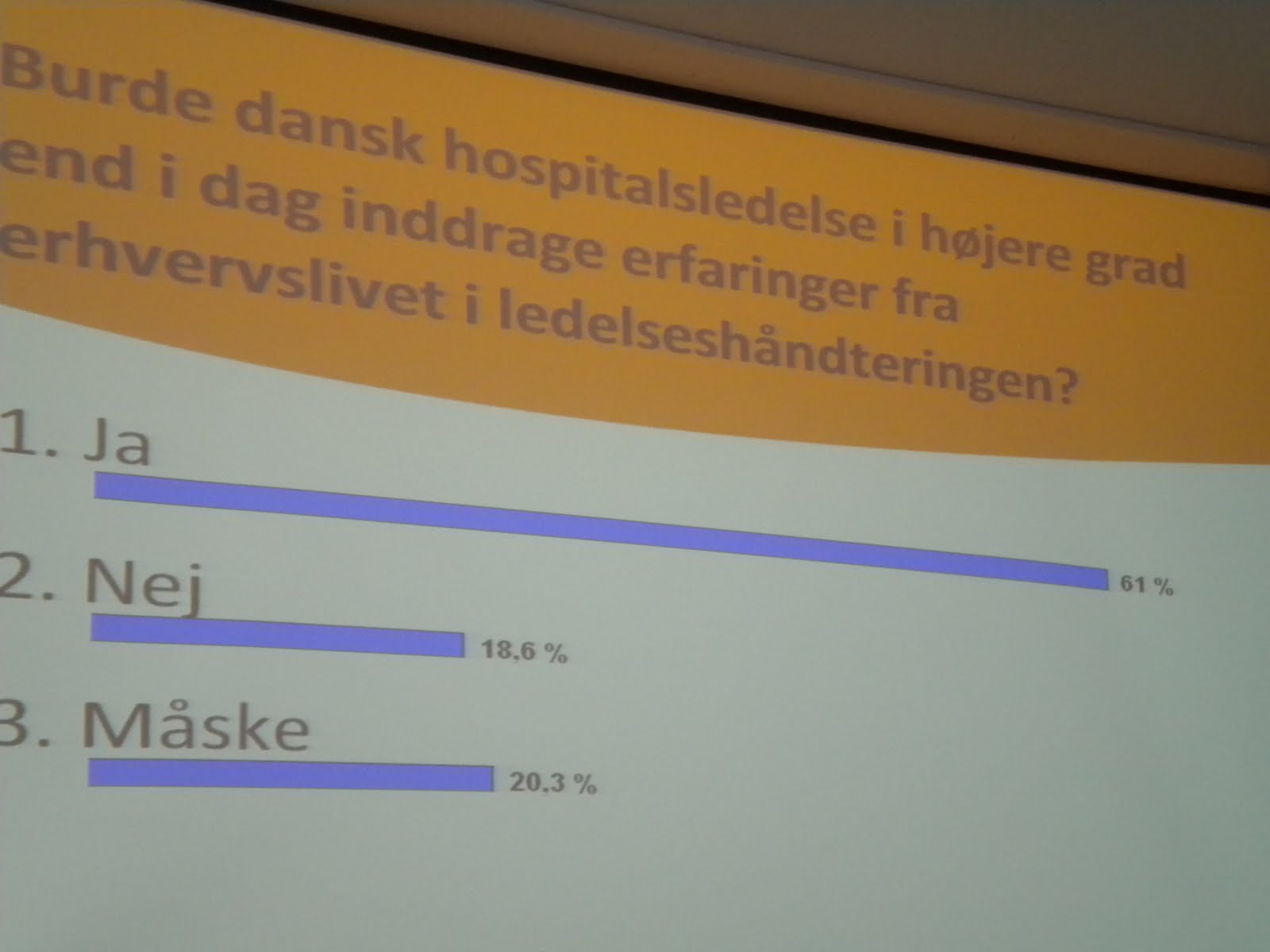
"Ja" is definitely the right answer. It is a demonstration of the intellectual modesty needed to make progress.
If you have made it this far, you have probably heard enough from me today. Just for entertainment, here's the actual song.
Click here if you can't see the video.
Saturday, April 9, 2011
The Infrastructure Chronicles -- Volume 4
Regular readers know that I am an infrastructure fanatic. They have either learned to tolerate that or quickly click to another site when they see a heading like the one above. What you might not know is that tunnels are a special interest of mine. You see, at the MA Water Resources Authority, we had to design and build quite a number of them, mostly drilled through bedrock. The longest was 9.5 miles under Boston Harbor, about 400 feet down, excavated with a 28-foot diameter tunnel boring machine, to disperse treated effluent into the ocean. I think it remains the largest single uni-directional bore in the world. (Some of you might put me in that category, too!)
 So, you can imagine my excitement upon encountering this behemoth, the Hvalfjörður Tunnel. As noted by Wikipedia, it is a road tunnel under the Hvalfjörður fjord in Iceland and a part of the Hringvegur (Iceland's ring road). It is 5,762m long and reaches depth of 165m below sea level. Opened on 11 July 1998, it shortens the distance from Reykjavík to the western and northern parts of the island by 45km. Passing the fjord now takes 7 minutes instead of about an hour before. You can get a sense from the accompanying map. The tunnel is at the lower left, while the previous route circumnavigates the fjord.
It is actually a bit scary to drive through, especially the first time. It is very long, with a long winding curve, not very bright lighting, and quite a gradient up and down (making it hard to maintain the 70 km/hour speed limit). I thought I would give you an impression of that, so I mounted a camera on my dashboard and produced this video.
Real infrastructure geeks will watch the whole video and complain that I did not film the entire ride. Regular people will say, "You made a video of a tunnel?!"
If you cannot see the video, click here.
 So, you can imagine my excitement upon encountering this behemoth, the Hvalfjörður Tunnel. As noted by Wikipedia, it is a road tunnel under the Hvalfjörður fjord in Iceland and a part of the Hringvegur (Iceland's ring road). It is 5,762m long and reaches depth of 165m below sea level. Opened on 11 July 1998, it shortens the distance from Reykjavík to the western and northern parts of the island by 45km. Passing the fjord now takes 7 minutes instead of about an hour before. You can get a sense from the accompanying map. The tunnel is at the lower left, while the previous route circumnavigates the fjord.
It is actually a bit scary to drive through, especially the first time. It is very long, with a long winding curve, not very bright lighting, and quite a gradient up and down (making it hard to maintain the 70 km/hour speed limit). I thought I would give you an impression of that, so I mounted a camera on my dashboard and produced this video.
Real infrastructure geeks will watch the whole video and complain that I did not film the entire ride. Regular people will say, "You made a video of a tunnel?!"
If you cannot see the video, click here.
Pastries, bicycles, and architecture
We can't leave Copenhagen without mentioning three important features -- pastries, bicycles, and architecture.
First, let's address the issue of Danish pastries, as we call them in the US. The original Danish pastry was actually made by bakers from Vienna who were in Copenhagen in the late 1800s. The Danes still call it wienerbrød.

However, it was modified from the original, so when you ask for it in Vienna by that name, they don't think it is their native pastry and so don't call it that. They call it Kopenhagen-Geback!
 Now, on to biking. This is a major mode of transportation in this city. In fact, this site notes, "According to the Technical and Environment Committee of Copenhagen, the Queen Louise Bridge - located in the the Danish capital's northern borough - holds the world record of daily passing cyclists with a staggering number of 36,000 people (!) crossing the bridge every day between 7AM and 5PM." They site further notes, "According to the Cyclist Embassy of Denmark, 36% of all Danish adults ride a bike to work."
This is made possible by a simple innovation now known worldwide as the "Copenhagen lane." This is a distinct and separate lane between the sidewalk and the street dedicated to bicycle traffic. It is physically separated by a height differential from the roadway. The bikes travel in the same direction as the adjacent auto traffic. At intersections, the lane is distinguished by blue paint, and there is often a separate traffic signal for the bikers.

 I have always been told that this would be too difficult to do in Boston because it is an old city with narrow streets. Hmm, Copenhagen is older and likewise has space limitations, but they have made it work. If you don't separate the lane, you get results like the one on Commonwealth Avenue portrayed on this web site.
But, being bike friendly goes beyond that. The city's Metro service is designed to encourage multi-modal transportation. Bikes are welcome, and the train cars are designed to leave room for them and to permit easy ingress and egress. Try that on the Boston "T" and see what happens!
 And, finally, architecture. The city has a spectacular mix of old and new, from this lovely bell tower with an external stairway on the Church of our Savior, Vor Frelsers Kirke, to new waterfront structures: The Royal Danish Theatre, the Opera House, and what is called the Black Diamond, a strikingly modern extension to the Royal Library. The walls are tilted in from the top, allowing it to reflect light and activity on the canal in front of it. Here is a view from our canal boat tour when the sun was behind us, as we approached and went past the building.
If you cannot see the video, click here.
You can find other views of the city on my Facebook page, here.
First, let's address the issue of Danish pastries, as we call them in the US. The original Danish pastry was actually made by bakers from Vienna who were in Copenhagen in the late 1800s. The Danes still call it wienerbrød.

However, it was modified from the original, so when you ask for it in Vienna by that name, they don't think it is their native pastry and so don't call it that. They call it Kopenhagen-Geback!
 Now, on to biking. This is a major mode of transportation in this city. In fact, this site notes, "According to the Technical and Environment Committee of Copenhagen, the Queen Louise Bridge - located in the the Danish capital's northern borough - holds the world record of daily passing cyclists with a staggering number of 36,000 people (!) crossing the bridge every day between 7AM and 5PM." They site further notes, "According to the Cyclist Embassy of Denmark, 36% of all Danish adults ride a bike to work."
This is made possible by a simple innovation now known worldwide as the "Copenhagen lane." This is a distinct and separate lane between the sidewalk and the street dedicated to bicycle traffic. It is physically separated by a height differential from the roadway. The bikes travel in the same direction as the adjacent auto traffic. At intersections, the lane is distinguished by blue paint, and there is often a separate traffic signal for the bikers.

 I have always been told that this would be too difficult to do in Boston because it is an old city with narrow streets. Hmm, Copenhagen is older and likewise has space limitations, but they have made it work. If you don't separate the lane, you get results like the one on Commonwealth Avenue portrayed on this web site.
But, being bike friendly goes beyond that. The city's Metro service is designed to encourage multi-modal transportation. Bikes are welcome, and the train cars are designed to leave room for them and to permit easy ingress and egress. Try that on the Boston "T" and see what happens!
 And, finally, architecture. The city has a spectacular mix of old and new, from this lovely bell tower with an external stairway on the Church of our Savior, Vor Frelsers Kirke, to new waterfront structures: The Royal Danish Theatre, the Opera House, and what is called the Black Diamond, a strikingly modern extension to the Royal Library. The walls are tilted in from the top, allowing it to reflect light and activity on the canal in front of it. Here is a view from our canal boat tour when the sun was behind us, as we approached and went past the building.
If you cannot see the video, click here.
You can find other views of the city on my Facebook page, here.
Subscribe to:
Posts (Atom)