Showing posts with label photos. Show all posts

Tuesday, February 8, 2011

Hanoi, Vietnam -- Exceeded all Expectations, Mystery Photo 4

Understatement: There are a lot of scooters in Vietnam.

      My expectations of Vietnam were probably somewhat low, though I had heard of other American tourists going there and enjoying the trip very much. There is a lot to see in this little country. The country is quite small in overall area, but it is also quite long. Therefore it is necessary for efficiency of travel to fly from one place to another. This post will primarily show Hanoi and Halong Bay. I have a lot of photos and there is a lot to show. Future posts will show more of central and southern Vietnam.

Above is the Ho Chi Minh Mausoleum in Hanoi, Vietnam, the subject of Mystery Photo 4

Below are two pictures of the Lenin Mausoleum in Red Square in Moscow. It is a red granite building much lower than the Hanoi building because it is backed up against the wall of the Kremlin. But the structure and style of the base is very much like that we see above in Hanoi.

     We flew from Chicago O'Hare with a short layover in Tokyo Airport, and then to Hanoi. The Mystery Photo 4 is of Ho Chi Minh Mausoleum in Ba Dinh Square in the center of Hanoi, Vietnam, where Ho read the Declaration of Independence for Vietnam,on September 2, 1945, establishing the Democratic Republic of Vietnam, then know as North Vietnam to us.  The flag of Vietnam is red with a  solid yellow star in the center. You see this flag hanging near the Mausoleum in the "hint" photo I provided. I wrote about visiting this Mausoleum in the December 12 posting. It was inaugurated August 29, 1975 and inspired by Lenin's Mausoleum in Moscow which we have also seen, though we did not wait in the very long line to go into that place. Here in Hanoi, there was not a real long line for some reason, so we were able to go inside. Being laid out like Ho Chi Minh is inside was totally against his wishes. He left a will that stated his wish to be cremated and have his ashes scattered in the hills of the north, central and southern Vietnam. He said he preferred cremation which is "more hygienic than burial and would also save land for agricultural purposes." But he was afterall the father of Vietnam reunification so the mausoleum is there in spite of what he wished.
                                         Lenin's Tomb backed up against the wall of the Kremlin
     One of the interesting characteristics of Vietnamese architecture is the narrowness of the houses. That is because it costs a lot to buy land fronting streets and roads, so the frontage of the houses is very narrow. But often these houses are 3 to 5 stories high and they are often painted bright colors and have very interesting decorations and styles. I have added several photos of these buildings from around the Hanoi area. Sometimes the houses look very strange because some have been built virtually by themselves in the countryside or in the suburbs standing tall and narrow all by themselves with no windows on the sides. I have
not seen this characteristic building anywhere else in the world. Even their cemeteries show this style of architecture in very small scale as you can see in the last photo.


One skinny house of Vietnam, out in the country.
                                 What the skinny houses of Vietnam are supposed to look like when put side by side.


The skinny house architecture carried over to the cemetery.

                                                 Water puppets for sale at a sidewalk shop.

The instrumental band for the Water Puppet show.

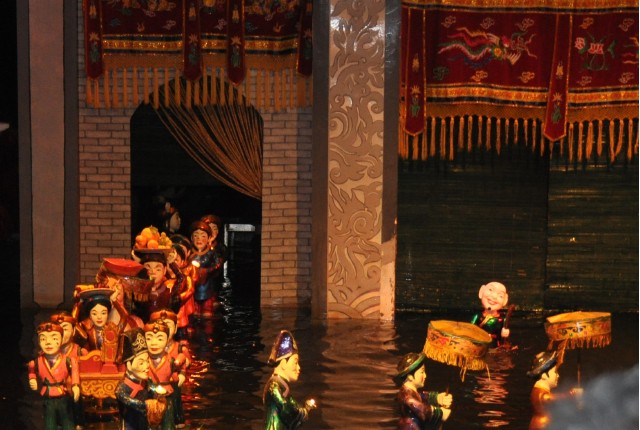
The National Vietnamese Water Puppet Theatre and its colorful stage.

                                 The water puppets in action. They are maneuvered on long sticks that are under the water. The manipulators are located behind the stage, reaching forward with the sticks.It was a ancient and very unique way to tell local folk stories.

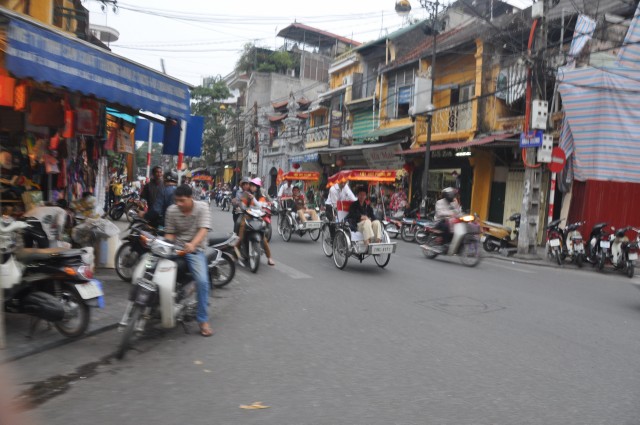
                                                                    The cyclo.

A famous bridge in Hanoi which leads to a famous Pagoda Temple. We had to get our photo taken on this bridge. Below are street scenes in the markets where Communist Vietnam practices their rampant capitalism.


   

                           Below two older men playing a board game in Ba Dinh Park, downtown Hanoi.


     Above is the entrance to what remains of the "Hanoi Hilton", the former French prison where dissidents were chained. Most of the large prison complex has been torn down and a high rise hotel tower has been built behind this remnant. Also the Vietnamese National Museum has been built on this property.  Below is a view from inside the Hanoi Hilton museum. Here are seen ceramic figures representing how the French imprisoned the dissident Vietnamese during their Colonial days. There is a section which is devoted to the time that American POWs were kept here, but as you can imagine there is some degree of propagandizing here: for example referring to the American devils, etc. I guess to them we were the Devils; obviously we were the enemy. But interestingly one whole room is devoted to John McCain, showing his history, telling how he landed in the middle of the well known lake in the middle of downtown Hanoi. They have his flight suit on display. They seem to be quite proud that a man who ran for President of the United States was housed in their prison for a bunch of years.
Below is the entrance to the Vietnam National Museum.

     Above is the Vietnamese National dress, the au dai for women. It consists of long flowing pants, with an overdress with a long panel in front and another long panel behind. The slim young Vietnamese women universally look gorgeous in these costumes. They are worn when the women dress up and for special occasions. And the women just mount their motor scooters with this beautiful dress.

     Below is a video of Halong Bay about 2 hours north of Hanoi. These limestone hills within the Bay are known worldwide. Take a look at this video panorama of this lovely site. Above that is a combination of these rock formations that is called "Kissing Chickens." You have to take your boat around to the proper angle to "see" the chickens. 
   

     I have lots more photos from Vietnam. I think I will have to post again just to get a few more out there. As I said, there was a lot to see in this energetic young country with an ancient past.

Thursday, November 4, 2010

Birds of Botswana

Glossy starling
     I promised you some photos of Botswana birds (also throughout Southern Africa). Here are some of my husbands expert photos.
     But first let me tell you a little how I got into birdwatching and how my husband got in to photographing them. As an adult I have always enjoyed keeping birdfeeders full all year around for the birds. During migration season and during invasions in the winter I enjoyed identifying the various birds that visited the feeders. We then lived in suburbs with housing closer together so we didn't see a lot of these migrants during the year. They did not nest locally. But we lived fairly close to the Milwaukee River, though not on it. I think this location was responsible for some of the attraction. Birds tend to use the River and its surrounds as flyways. I think my first birding trip occurred when we went to Israel for a visit in the 1980s. My husband needed to stay to visit his family there, but I had signed up for a Spring Migration Festival in Eilat, on the Red Sea. That was an interesting time. I will tell that whole story in another posting. Over the years I have attended a few other birding festivals. But mostly during our many travels, I have tried to birdwatch while my husband tears on ahead in the trip. He is not one to stop along the road to identify a special bird I spot through the window, or even to slow down our siteseeing strolls to identify a bird. But then we found some cooperative great blue herons and great egrets which were content to stand still for him to get quite close with his camara. He got some good shots and that is how the bird photography bug bit him. Now he doesn't have the really heavy and long lenses so small birds are not good subjects. But there are a lot of fairly large birds around the world. Africa is certainly no exception. In fact I think there are many more large birds there than in North America and even some of the smaller birds seem to be unafraid of people and pose quite naturally for photography. I think he got some beautiful photos while in AFrica. I have loaded some of them here on this post.

black backed vulture

lilac breasted roller
red billed hornbill

Spotted dikkop or thick knee
helmeted guinea fowl

Kori bustard

black stork

darter

African fish eagle

bee eater
squacco heron
 This is the limit of these high resolution photos that I can fit on this website. There were many more birds seen, but will have to post them another time. Let me know by email, or in comments if you would like to see more.


Tuesday, October 12, 2010

Like a Bird by Asaf Solomon

Bird's Eye View

"Asaf Solomon, a dedicated Galilean, nature lover, and farmer, photographs the land of Israel while flying over it in a powered paraglider, a picturesque craft that gives the passenger a sense of freedom and tranquility, as well as the opportunity to take photographs from an unorthodox angle."
 
The above introduction is from the Magazine Eretz. We have his book "Like a Bird" showing his magnificent photographs of the land of Israel from the sky. Patterns, birds, nature and archeological landmarks vy with each other to produce a view of Israel that I have never seen. I have been there 7 or 8 times and of course my husband lived there until he was 33 years old. But every time we go to that little country we find something new to see. There is a new national park, or some new event to see. This little country unbelievably has 60 some national parks. They do a wonderful job of preserving their important holy legacy -- holy in three religions. But this book shows still a new view. I recommend you get this book if you can find it. It is in Hebrew, but that doesn't matter; you will just miss out on the short titles of each photo. But the photographer Asaf Solomon has a website and you can see a few of his views there. This book is a wonderful coffee table book of a smaller nature and will certainly arouse interest and conversation in your home.
 
"Like a Bird" by Asaf Solomon. 2009 Kinnaret, Zmora-Bitan, Dvir -- Publishing House Ltd. St. Or Yehuda 60212, Israel  ISBN 978-965-517-351-2
http://www.kinbooks.co.il/


     The above photo is taken from the jacket cover of the book. It is copyrighted and printed here with permission of publisher and author. It is my favorite. It shows the Star of David plowed up in a field, in the Hula Valley in the north of Israel. We have been there in the fall of the year when 10s of thousands of cranes are stopping there on their yearly migration from Europe to winter in Africa. In this photo, the tractor is scattering seed just on the Star of David outline. The cranes are therefore landing and feeding on the Star. For a lover of Israel and a birdwatcher like me, this is a wonderful photo.

Thursday, August 12, 2010

House Guests: Israeli and American culture mix.

     Last week my husband and I had an Israeli couple as house guests for the whole week. The man and my husband go way back -- to infancy in Israel. Hubbie was the first born child to Kibbutz Avuca in Pardes Hannah, Israel, in 1936. This kibbutz had been formed by new immigrants to Israel from several shtetls in then Bessarabia in Eastern Europe (now the independent country of Moldova), most people originating in Kalarash and a few members from Dombroven. These young adults had been bitten by the Zionist movement in the 1930s and joined the youth movement Gordonia to learn agriculture in a camp funded by the Jewish Agency before their emigration to Israel. This group of people were very close and established the socialist community known as a kibbutz in about 1934. They received land near Pardes Hannah, Israel and worked that land. They did not have a completely set off village as most kibbutzim with more money did. So they often occupied living space outside of the kibbutz owned buildings. But the children were tended in a nursery as was typical of the time. The firstborn child, my husband, became the child of the whole kibbutz. He was adored and doted, and probably spoiled. But within 2 years there were 7 children and our house guest last week was the 7th child. He is the furthest on the left lower corner of bottom photo, and my husband is the child next to him.
     Unlike my husband, Miram stayed in Israel. He served in the military and was teaching the use of grenades when one went off and severely injured him, causing loss of hearing, and loss of one eye, and multiple shrapnel wounds requiring several surgeries. He later became a lawyer and then a judge in Pardes Hannah. He is now partially retired. His wife was a nurse. Miram met her while undergoing all of his reconstructive surgical procedures. My husband had not been in touch with him for some time but he came to visit my mother in law when she was aging in an assisted living arrangement in Israel. My husband ran into him on that visit and renewed acquaintances. Recently an acquaintance was renewed before our trip back to Moldova as Miram has a cousin still living in Kalarash. We learned that Miram and his wife were coming to visit another cousin in Minneapolis and asked them to come visit us as well.

     We showed them some of American culture which was entirely new to them, of course. Some Israelis tend to be a bit provincial; many do not have the money to travel and of course the Jewish culture there is in some senses very narrow. Therefore we were happy to show off America, at least America as it is represented in our little Midwestern sliver of the wider scene. The first day my husband took them to the state capital in Madison, and up on Bascom Hill. They saw where my husband and I met and where we used to live on State Street, and just in general got an impression of the city often voted into the top 10 of the most pleasant to live in the United States.

     The second day we took them down to Chicago, went up on the Willis Tower, visited Navy Pier for lunch, and drove around to view the lovely Lake Michigan waterfront of the Windy City.  We returned to Milwaukee and a surprise for Miram and Rivka. The Israeli Tzofim (Scouts) Youth Group is traveling around the US for 2 months and were performing in Bayshore Town Square. We stopped there on the return from Chicago and witnessed a very entertaining song and dance show. And confirming the Small World Theory, one of the 10 young people was a friend of Miram's grandson. They got to visit together after.
     The next day included attendance at my husband's annual retirement picnic and a visit to the Mitchell Park Conservatory Domes. The following day we took them to a Brewer Baseball game against the Houston Astros and explained in detail the rules of a game that is totally foreign to Israelis. A stop on the way home at Kopp's for their famous hamburgers and ice cream demonstrated the Milwaukee institution that Doc Severson used to visit every time he was in town conducting the Milwaukee Pops Symphony. (He always used to ask the audience from the conductor's podium, "Does anyone know today's ice cream flavor at Kopp's?" and the audience would fill him in.)
     The last day with us, we dropped them off at the Milwaukee Public Museum to see the butterflies, the dinosaur exhibits, the Streets of Old Milwaukee, and European Village exhibits and an IMAX show on the oceans. Mixed in between all these activities were lengthy discussions in Hebrew about life in Israel, life here in the United States, and the differences and similarities of the two cultures. I improved my Hebrew a little bit again by hearing so much of the language. These two spoke English but of course it is easier for my husband to explain things to them in Hebrew. Although Hubbie admits that now he has an immigrant's English which he regards as less than perfect and a Hebrew that is horribly outdated. This living ancient language has had to modernize to accommodate modern technological society and many new words are unrecognized by my husband. 

     We were together for a week and there was only one brief period of contention. This occurred when we were at Kopp's. We had taken them to several restaurants for dinner. The ordering process was always a bit tedious and lengthy, because they really wanted to know what they were going to eat and to make a very personal choice from the menu, while my husband tended to want to choose for them because he felt he knew what would be best. One of the recurring discussions revolved around how to order the steak. Israelis always order steak well done, and grilled steaks can not be well done or the outside of the steak is like shoe leather. We always tried to get them to modify this order and at least say, medium well, tending toward medium. But it was difficult. Many times they just ordered fish. But the night of the Kopp's visit, my husband wanted to demonstrate an American hamburger done as only Kopp's can do them. Also anyone familiar with a busy Kopp's knows that when you step up to the grill counter to order, you have to be ready to go and spit out your desires rapidly because there is a line of people with similar desires behind you. This is not the time to be discussing the menu or changing your mind. After my husband had ordered everything, the guest wife decided she wanted the chicken instead of a hamburger, so the clerk had to change the order on the computer and then Miram began to think again about what on the menu list overhead he wanted. My husband lost it and raised his voice and told them he wanted them to try the hamburger and that was that. I stepped in and quietly told the clerk to change one hamburger to chicken and then ordered the sides and the drinks. Everyone was a little subdued after that public argument, but we survived and no one held a grudge. It should be noted that this disagreement was more than the usual Israeli disagreement. I learned long ago shortly after I got married that Israeli discussions often look like arguments to someone who is not accustomed to the heated repartee that occurs in this somewhat hot-headed Mediterranean country. We had lots of discussions like that during our guests stay, but that is different. This public disagreement was not in that category. It was a definite strong chastisement by my husband and made everyone uncomfortable for a while.
     Still it was a pleasant week. We enjoyed showing off our home. We enjoyed showing off what Milwaukee and Wisconsin has to offer. And also, like most people who have had house guests, we enjoyed getting our house back to ourselves after they left. 

Sunday, August 8, 2010

The Year of Biodiversity

     Did you know that the United Nations has declared 2010 The International Year of Biodiversity? According to a short National Geographic article in the May issue, Pp 30-35, Paul Hebert, University of Guelphe in Ontario, spent 5 year in the 1970s barcoding moths and butterflies from New Gunea. Overwhelmed by the 2,000 different species he moved to water fleas where there are only 200 species known. These barcodes are made by coding for the 600 spots on the CO1 gene which codes for ATP, a necessary enzyme in virtually all multicellular lifeforms on this world. Those 600 spots will be occupied by one of 4 different DNA bases. These barcodes are different among all creatures almost universally. This allows every multicellular creature on earth to have a different barcode. Researchers around the world are now attempting to barcode 500,000 species, out of the 1.7 million already named species from around the world. The plan is to have all these 1.7 million species barcoded by the year 2025. There is some controversy with this goal, some scientists feeling we should be working on identifying and naming more species that are unknown at this time. Some scientists, however, think that barcoding will become readily accessible and that DNA readers may allow even non scientists to barcode species that they have in their own backyard, producing more information about known pest species and possibly identifying those unknowns more quickly.

     I would like to have a similar barcoder for people. Wouldn't it  be cool to barcode that person down the bar from you to determine what species he is. Is he an introvert or an extrovert; is she outgoing or shy; are those two honest citizens or are they criminals (or in today's current events) Russian spies? Will that person be my friend or my enemy? Barcoding could certainly help us in these relations.
     Today we have literally thousands of dragonflies flitting around our backyard near Lake Michigan.  I did some research and identified
these large 3 inch green and purple dragonflies as the common green darner. These harmless but impressive dragonflies have a life cycle much like the monarch butterfly. The adults migrate south in the fall. The adults winter over in the south and then start a new line of offspring which slowly work their way north until a generation reproduces in our area. So these adults are no doubt starting their migration. We welcome them for the mosquitoes they are eating as they fly about our backyard.
Female green darner dragonfly


Yellow swallowtail butterfly


Bumble Bee

Friday, March 26, 2010

New blog: Check it out!

I have posted new photos on my other blog at www.aarp.org/community/renrae

That blog contains my birding journals. I am currently taking two weekly bird walks at either Havenswood State Forest, in Milwaukee, WI or at Kletsch Park along the Milwaukee River in Glendale. This is the first year that I have followed the spring migration weekly. It is interesting to note the chronology of bird arrivals.

My husband's photo of Iguasu Falls in Argentina (above) got bookmarked by the communityhost of AARP blog site.

Among my world wide travel photos at that site, the elephant photo got the most hits, nearly twice as many as any of the other photos in that album. I wonder why! I have a whole series of elephant photos leading up to this one. Perhaps I should locate the whole series on the aarp site. Check it out and let me know if you want to see more of these anatomically correct photos. Interestingly, our guide told us that these two elephants were both males, because they were in a herd of young males, traveling together. Females and their offspring are in other herds and a male and female only is together long enough to mate. This photo raises a question about that or else young male elephants are like dolphins and humans.