Showing posts with label Vietnam. Show all posts

Tuesday, February 8, 2011

Hanoi, Vietnam -- Exceeded all Expectations, Mystery Photo 4

Understatement: There are a lot of scooters in Vietnam.

      My expectations of Vietnam were probably somewhat low, though I had heard of other American tourists going there and enjoying the trip very much. There is a lot to see in this little country. The country is quite small in overall area, but it is also quite long. Therefore it is necessary for efficiency of travel to fly from one place to another. This post will primarily show Hanoi and Halong Bay. I have a lot of photos and there is a lot to show. Future posts will show more of central and southern Vietnam.

Above is the Ho Chi Minh Mausoleum in Hanoi, Vietnam, the subject of Mystery Photo 4

Below are two pictures of the Lenin Mausoleum in Red Square in Moscow. It is a red granite building much lower than the Hanoi building because it is backed up against the wall of the Kremlin. But the structure and style of the base is very much like that we see above in Hanoi.

     We flew from Chicago O'Hare with a short layover in Tokyo Airport, and then to Hanoi. The Mystery Photo 4 is of Ho Chi Minh Mausoleum in Ba Dinh Square in the center of Hanoi, Vietnam, where Ho read the Declaration of Independence for Vietnam,on September 2, 1945, establishing the Democratic Republic of Vietnam, then know as North Vietnam to us.  The flag of Vietnam is red with a  solid yellow star in the center. You see this flag hanging near the Mausoleum in the "hint" photo I provided. I wrote about visiting this Mausoleum in the December 12 posting. It was inaugurated August 29, 1975 and inspired by Lenin's Mausoleum in Moscow which we have also seen, though we did not wait in the very long line to go into that place. Here in Hanoi, there was not a real long line for some reason, so we were able to go inside. Being laid out like Ho Chi Minh is inside was totally against his wishes. He left a will that stated his wish to be cremated and have his ashes scattered in the hills of the north, central and southern Vietnam. He said he preferred cremation which is "more hygienic than burial and would also save land for agricultural purposes." But he was afterall the father of Vietnam reunification so the mausoleum is there in spite of what he wished.
                                         Lenin's Tomb backed up against the wall of the Kremlin
     One of the interesting characteristics of Vietnamese architecture is the narrowness of the houses. That is because it costs a lot to buy land fronting streets and roads, so the frontage of the houses is very narrow. But often these houses are 3 to 5 stories high and they are often painted bright colors and have very interesting decorations and styles. I have added several photos of these buildings from around the Hanoi area. Sometimes the houses look very strange because some have been built virtually by themselves in the countryside or in the suburbs standing tall and narrow all by themselves with no windows on the sides. I have
not seen this characteristic building anywhere else in the world. Even their cemeteries show this style of architecture in very small scale as you can see in the last photo.


One skinny house of Vietnam, out in the country.
                                 What the skinny houses of Vietnam are supposed to look like when put side by side.


The skinny house architecture carried over to the cemetery.

                                                 Water puppets for sale at a sidewalk shop.

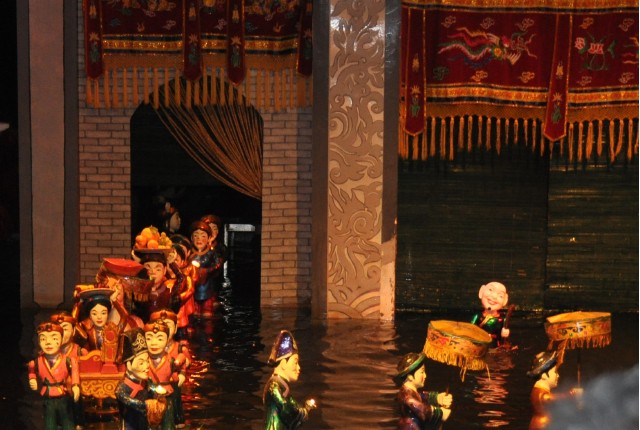
The instrumental band for the Water Puppet show.

The National Vietnamese Water Puppet Theatre and its colorful stage.

                                 The water puppets in action. They are maneuvered on long sticks that are under the water. The manipulators are located behind the stage, reaching forward with the sticks.It was a ancient and very unique way to tell local folk stories.

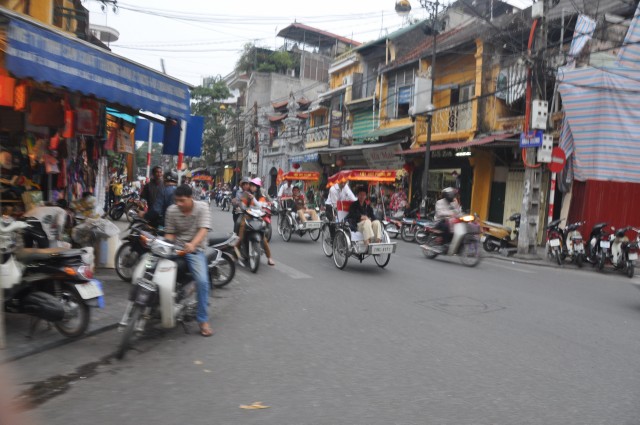
                                                                    The cyclo.

A famous bridge in Hanoi which leads to a famous Pagoda Temple. We had to get our photo taken on this bridge. Below are street scenes in the markets where Communist Vietnam practices their rampant capitalism.


   

                           Below two older men playing a board game in Ba Dinh Park, downtown Hanoi.


     Above is the entrance to what remains of the "Hanoi Hilton", the former French prison where dissidents were chained. Most of the large prison complex has been torn down and a high rise hotel tower has been built behind this remnant. Also the Vietnamese National Museum has been built on this property.  Below is a view from inside the Hanoi Hilton museum. Here are seen ceramic figures representing how the French imprisoned the dissident Vietnamese during their Colonial days. There is a section which is devoted to the time that American POWs were kept here, but as you can imagine there is some degree of propagandizing here: for example referring to the American devils, etc. I guess to them we were the Devils; obviously we were the enemy. But interestingly one whole room is devoted to John McCain, showing his history, telling how he landed in the middle of the well known lake in the middle of downtown Hanoi. They have his flight suit on display. They seem to be quite proud that a man who ran for President of the United States was housed in their prison for a bunch of years.
Below is the entrance to the Vietnam National Museum.

     Above is the Vietnamese National dress, the au dai for women. It consists of long flowing pants, with an overdress with a long panel in front and another long panel behind. The slim young Vietnamese women universally look gorgeous in these costumes. They are worn when the women dress up and for special occasions. And the women just mount their motor scooters with this beautiful dress.

     Below is a video of Halong Bay about 2 hours north of Hanoi. These limestone hills within the Bay are known worldwide. Take a look at this video panorama of this lovely site. Above that is a combination of these rock formations that is called "Kissing Chickens." You have to take your boat around to the proper angle to "see" the chickens. 
   

     I have lots more photos from Vietnam. I think I will have to post again just to get a few more out there. As I said, there was a lot to see in this energetic young country with an ancient past.

Monday, December 13, 2010

Vietnam on our trip to Southeastern Asia, December 13, 2010

     APOLOGIES!! Just when my readership numbers were getting up there, I don't post anything on blogger for 6 weeks. A sure way to lose your interest, dear readers. But I have a good excuse and not only that this last trip will provide gist for several new travelogs. Yes, that is correct. We took another trip!

     On November 13, we flew 13 hours from O'Hare to Tokyo, endured a 2 1/2 hour layover in the business lounge in the Tokyo airport, and then flew 5 1/2 hours from Tokyo to Hanoi. A Very Long Trip!. But such is the requirements if we want to travel 1/2 around the world -- exactly 12 hours away. This trip would take in several locations in Vietnam; Angkor Wat, Cambodia; and Chiang Mai and Bangkok, Thailand.

     Vietnam was very interesting. My husband and I were very pleasantly surprised about this young country. We were a little worried as Americans traveling to a place where we were the enemies about 45 years ago. But actually 72% of residents of Vietnam are 29 or less. Such a young population has little memory or concern about a war that took place before most of them were born. However, we did take a walk through the central park of Hanoi where the Ho Chi Minh mausoleum is and also where his house is. It was a Sunday and there was a day off of work. Everyone was out in their finest. There were several older men in their full military uniform and a couple were sporting their medals on their lapel as well. We Americans did get "a long serious look" from these men. Our guide says that the guides and drivers like Americans, probably because we know how to tip the guides. We know from personal observation that Europeans do not tip at all during guided tours.

     Some further comments about Vietnam:

     On walking through the Ho Chi Minh Mausoleum. We were asked to line up in a line of pairs or single file. We had to slowly walk from the admittance gate through metal detectors. Cellphones and other electronic gear had to be checked. You could carry only one shoulder bag. Along the street, through the turn into the building, up the stairs and into the viewing room, there were guards posted all along the way. They reminded us to stand up straight, take our hands out of our pockets, hold any purse or bag still in our hands in front of us, not swinging wildly from our shoulders, and we were shushed several times. In this way a very subdued and respectful line filed past the venerated leader of North Vietnam who tirelessly worked for the unification of the North and the South. Of course, he also led the Communist Party to power which subdued the South and made it Communist as well.

     On freedoms in the People's Republic of Vietnam: We were standing at the check in desk of our hotel in Hanoi, when the bellhop came over to stand with me while Amos did the last signing for check in. He asked, "Is this your first time in Vietnam?" Strangely virtually everyone asks this question here. Do they think that US citizens go to Vietnam every few months because it's so exciting to visit?
"Yes," I answered. "We have traveled a lot, all over the world and now it is Southeast Asia."
"I will never be able to travel like that. It is very difficult to get a passport to be able to leave the country. And then it cost a lot of money." volunteered the bellhop.
I said, " Oh, you are very young. You can put away some money and you will be able to travel yet. You have time."
"No, I will never be able to travel outside my country," said the bellboy. "My parents both worked for the US government during the war, so never will I be able to leave."

    You see Ho Chi Minh's ideal came true, but now the whole country is not free.

    But we were very impressed by the people. They are hardworking, honest, and very friendly. We were in the Mekong Delta, walking through the jungle, to visit a small village and a small village tea house. Here while having tea, we were listening to a small group play and sing  with traditional Vietnamese instruments. An elderly grey haired lady was watching us. She then saw the scar on my arm and came over and touched my arm with a great look of compassion on her face. I was touched.

    The Vietnamese are very clean. The ladies and older young girls often still wear the traditional dress. It is called the au dais and consists of two long panels of colorful cloth, sometimes plain color, sometimes with a print. They hang from the waist and are totally open on each side. Underneath these panels, the young women wear long slim pants in a complimentary color. The cloth is either silk or nylon. The women appear very attractive in this outfit.

     The "Hanoi Hilton" was listed on our itinerary. But it appeared that our guide, Nam, in Hanoi was going to over look it. At one point, he said we would be driving by it and we would be able to see it from the road, that he would point it out to us. We were almost by it when he said something like, "That building back there was the "Hanoi Hilton", you know where your Senator John McCain stayed while he was here." We told Nam that we were supposed to see the inside of the museum there and could we please stop. He seemed reluctant but spoke with the driver and we turned around so that we could park and go inside. What is present here is only the entrance and two small wings on each side which now serve as a museum. The rest of the large prison complex which the French used also to house dissident Vietnamese has been torn down and there is a highrise modern hotel on the site. Inside about half of the museum is devoted to the brutality of the French during their control of the country. Then there is a section with propaganda about the "American War" as they call it. There is one room about John McCain with his flight suit and photos of when he was dragged from the Lake in the middle of downtown Hanoi. He certainly picked a lousy place to crash land his plane. It seemed during the whole walk through, that our guide was hurrying us through. It was the only time that we felt uncomfortable about our visit here, and I am still not sure why our guide didn't want us to visit this place.

     In driving up and over the pass through the mountains between Hue and Danang, we made a stop at the top of the pass. Above all we needed a restroom, but also we wanted a chance to photograph the view of the sea below. By the time I made my way from our car door to the restroom inside the tiny building, a young Vietnamese woman knew that my first name was Ann, that I was from Milwaukee, WI, that I had two grown sons and two grandsons, that I was in Vietnam on vacation for the first time, and I had learned that my young attendant's name was Lien and she had four children and a fifth on the way. When I came out of the small, slightly primitive but immaculate restroom, there was already hot coffee and hot tea set out for us. And now Lien began her hard sell. She sat in front of a narrow pressed aluminum table with trays of beads and bracelets all set before here. She seated us in the plastic lawn chairs and began her hard sell on the tiger eye bracelets that had caught my eye. She began to make me a larger bracelet for my wrist and when she saw that I was going to buy this, she began working on my husband to make one for him as well. Just working the bracelet and talking, laughing, joking and selling, Lien was a delight. I couldn't help but buy from here, and we bought two such bracelets.

     I had a mission during this trip. I had in my possession a little 8 inch tall stuffed dog named Owney which was purchased from the Smithsonian Museum. He represents a true dog that existed in the late 1800s and became a mail dog, riding on mail railroad cars all over the US. The postmen fed him and attached mail tags to his color and later to a jacket someone made for him. The Smithsonian sells children's books about Owney's story and this stuffed version of the dog. I took him along with me to get pictures of him all over Southeast Asia so that we can use those pictures and postcards home that he sends to involve our youth stamp club in countries around the world and their stamps. I explained this mission to Tom, our guide in Saigon. Tom is in his twenties and unmarried. He was taken by Owney and volunteered to carry him around until Amos could get some pictures of Owney near some of the sites. I explained to Tom that Owney would be a "chick magnet." He looked puzzled so of course I had to explain what a chick is: a young attractive woman and how the word magnet applied to this situation. He finally understood. And indeed females of all ages and even some boys and young men came over and petted Owney and commented about him to Tom. When we were at the teashop in the Mekong Delta, that grey haired lady made a fuss over Owney and over Tom. I turned to him and mouthed the words: "Chick magnet". He understood. I should really send him an Owney of his own.

     In Saigon, we visited the buildings that had housed the government of South Vietnam. Tom conducted a very nice walk through here. Then we were in the Museum of War Remnants. This museum is very much like similar museums in Russia. The ground floor and outside court are full of various armaments from all wars and both sides, so here there are both Chinese and US planes and tanks, and munitions. On the second floor are photos with propaganda along side showing the so called "atrocities of the American devils." But on the thrid floor was a photo display that Tom said on the way up the stairs, "will show you how things really were." It was a photo display that toured the US and then was gifted to Vietnam and as far as I could tell was mounted without changing the explanations. I could discern no propaganda. It honored journalists that were killed in the Vietnam War and featured their often award winning photo credits. There were at least 3 spreads from Life Magazine. I found a journalist that had actually photographed WWII and then as a grey haired woman had insisted on coming to Vietnam to photograph that war. She was from Shorewood, WI, our neighbor. I had never heard of her. She died their on the battlefields of Vietnam, killed by the war.

     My husband is still organizing our photos from the trip so in this post photos are notably missing. But that will allow me to post again on this country. You have to see some of the photos of the beautiful Halong Bay.
Don't forget about my blog. I am back and will be regularly posting again for some months before we take another trip. It's good to be home.