Showing posts with label birding. Show all posts

Wednesday, August 17, 2011

Mystery Photo 12: Cuernos del Paine in Torres del Paine National Park, Chile, South America

     My husband took this mystery photo number 12 during a trip to South America a few years ago. This was the trip that ended up in Antarctica. But second to Antarctica and also perhaps Iguasu Falls, this national park in Chile was very impressive. We hired two young people to guide us privately rather than take the bus tour that the cruise ship offered. We just thought that we would leave earlier and perhaps be able to get back a little later as long as we caught the ship's sailing. And we thought we could define our tour of this highland country better, skip what we were not interested in and get on to the areas that did interest us. We thought that we would save time and see more by not having to all board a bus after each stop. Indeed it did work out that way for us. Read More in order to hear about this section of our South America/Antarctica trip and to see more gorgeous photos.
     The young couple who guided us were brother and sister in law tour guides in a small tour company that does primarily adventure touring in Torres del Paine. That would include backpacking, hiking, trekng, kayaking, mountain climbing, white water rafting, fishing, and other types of touring that we at our age were not going to do. Therefore, for them our tour was a different kind of challenge. They had to be careful to not get us into a situation that would be too physical for us and yet try to make sure that we could view many of the great vistas and wildlife available in this wild corner of the Patagonian mountains. The young man took charge of me and the young woman of my husband. There were a couple of occasions where my husband wanted to hike further to get a better shot with his camera, and I was pooped and decided to stop. This split us up and each was required to make individual decisions about where and how to guide us. You will see one example of this in the photos where I will explain.
     Torres del Paine National Park is in the extreme south of Chile, nestled between the heel of Argentina in the southern Andes Mountains, in an area that has long been known as Patagonia. It is located 70 miles from Puerto Natales where our cruise ship stopped. The park area was first written about in 1880 by Lady Florence Dixie. It was quite remote and did not become a national park until 1959 when it was called Grey Lake National Park. Its present name was bequeathed in 1970 and in 1978 it became a UNESCO World Biosphere Reserve. Torres del Paine is a combination name where Torres means towers in Spanish, and Paine is an aboriginal word meaning blue.  The park encompasses the Paine massif, a large hunk of mountainous granite which was created by geological forces when magma pushed up into the most fantastic rugged sharp peaks in the world, about 12 million years ago. Some of the peaks such as the Cuernos (Horns) del Paine are capped by darker sedimentary rock from an ancient sea in the area providing striking light and dark rock bands that are identifying characteristics of this massif. Also included in the park are glaciers, and many lakes. In one case the Grey Glacier flows into Grey Lake at the base of the Paine massif, near the Cuernos del Paine. There are several lakes, tumultuous waterfalls, and exciting animals and birds. You will see some photos below that are representative of this fauna. The lovely exception of this park is that you can view all these magnificent mountainous views and glacier views without risk of altitude sickness. The high rugged peaks of the mountain tips here are between 6500 and 9000 feet -- Towers 8 - 9 thousand feet high, the horns are 7 - 8 thousand feet high . The hiking and viewing is done from about 150 to 800 feet elevations. Some of the trails may reach 1500 feet but we did not see those areas. These mountains are similar to the Grand Tetons and perhaps even Mount McKinley in Alaska where they rise about 5000 to 8000 feet from a relatively level or rolling plain around their base. This is what provides for the gorgeous views.
     Several hiking trails encircle and perforate this area. Since it is a World UNESCO reserve, you are not allowed to hike off the trails. We did not do any of these hikes but younger people would enjoy them immensely. There is a circuitous route that takes about 7 or 8 days to complete. There is a W shaped route which takes 5 or 6 days and then there are day trips from various sites within the park. The long trail hikes are unique because there are refugios positioned at places along the trail that allow a days hike and then a place to spend the night.
     Some of these refuges have buildings, and facilities, as well as on duty cooks. Others are more primitive and are just campsites. We felt that our guides gave us some very nice views by driving the roads of the park and stopping to get some good views. See what you think by looking at the photos below.


We left early. This is sunrise striking the Paine massif in the distance.


Approaching the Paine massif, with the Torres del Pain, being the three towers to the right.


Here's our carriage of the day -- a Land Rover with my charge person.

Guanacos are common here in certain parts of the park. They are cousins to llamas and alpacas, but unlike their cousins, they were never really domesticated. However, they are not frightened of people and usually just look curiously at us and then go on with their grazing. The next three photos show these cute animals and their gorgeous surroundings in Patagonia. 


The broad Paine massif with one of its surrounding lakes.


The above two photos show the Cuernos del Paine -- Horns of Blue. They show a slightly different angle of view and also what a little change in the light can do, all within a matter of minutes.

These two photos show the Great Falls of the Paine River which runs through a half dozen lakes and completely surround the Paine massif. There are also multiple small lagoons created by glacier melt water and run off. This makes multiple bodies of water but unfortunately they are icy cold and not so good for many water sports.


Wild horses galloping across the Pampas.


Grey Lake with icebergs from Grey Glacier, and Cuernos del Paine up above.


Grey Glacier with its foot in Grey Lake. Her the water if milky grey due to suspended rock particles.

     At Grey Lake, we took a walk with our guides. We had to walk around a peninsula of land and out across a rocky shore in order to get a view of Grey Glacier. All of us started the walk, but the wind was blowing fiercely, coming down off that glacier and then across the water. Sometimes even on sunny days in this location and also others in the park, the wind can reach 70 miles per hour. I don't think it was quite that strong when we were there, but it was certainly not just a slight breeze. It was difficult to walk. I said I wasn't going any further. I would sacrifice the view of the foot of Grey Glacier. But my husband was stubborn and so he and the young woman guide took off across the gravel. At one point he had to sit down, he became so fatigued but he got his photo of Grey Glacier with its foot in Grey Lake.


The Chilean flamingo, a special species found mostly in these lakes.


Here is the famous Andean condor, a bird with a wingspread of 10 ft, second only to the Wandering Albatross.


Here the water is a neon turquoise also due to suspended rock particles. The glaciers grind up the granite into dust which when refracting light produces these brilliant lakes.


Tuesday, June 28, 2011

Bluebirds! Yea!

     This year has been a tough one for MY bluebirds. I use the word MY because I have had bluebirds in one and many years two boxes for as long as we have lived here (since 1997). But this year has been difficult. There was a pair trying to use the box in the backyard in May, but the tree swallows were protective of that box, even though tree swallows don't nest until later and only raise one brood. But apparently they like to stake out a box in advance of their needs. Now I don't evict tree swallows because they are desirable birds also. In the end they didn't even use this box, perhaps because sparrows took over.
      My two boxes in front were also commandeered by sparrows. I have faithfully evicted the house sparrows from all three boxes for the last 6 weeks but they just wouldn't give up. I would open the box and scrape out the nest materials and within a few hours the box was full again. So no bluebirds in either of the two boxes in our front yard. Finally the sparrows did give up but now there has been a male wren filling the boxes with sticks. A male wren will fill every box in the area to the brim with sticks and then only use one box when the female joins him. I was out in my "wild" area in my front yard (My husband calls it my jungle.) and I heard and saw the male bluebird just last week, so I knew he was again in the market for a house. This is probably he and his mate's second nesting. Bluebirds will nest 2 to 3 times in a summer raising usually 4-5 young each time. Sometimes that summer's first brood will even help raise the second brood and so on. What was I going to do with the wrens? So I found an old box without a hook on it and just laid it atop my trellis near the bluebird house and just kept emptying the bluebird box of sticks. Finally as I drove out of the drive this morning, I saw a flutter of blue around the blue bird house and the wren was singing from the trellis box and going in and out of it. So maybe I have finally made peace in the bird world in my yard.
     I miss the bluebirds when they are not here. They are such gentle birds and I love their soft bubbly call. Both help build the nest. The female incubates the eggs for about 14 days. But the male is ever attentive. He sits watch in a nearby tree, and occasionally brings the female an insect. Every evening at dusk, the male goes to the box hole and checks on the female before he goes to his night roost. Sometimes he will bring her one last insect before he disappears. Both parents feed the hungry young. They are often seen on various of their hunting perches around the area of the box, from which their sharp eyes spot insects on the ground. Then they flutter down and catch the insect and take it to the young. Shortly after we had moved into our new house, there were a couple of 2 X 2 inch stakes in the backyard put there as markers for the landscapers when they finally came to seed our grass. The bluebirds began using those stakes as hunting perches in the middle of the yard. I always said I was going to make a fortune producing these 2 X 2 stakes, paint them blue and print on them in black: Bluebird Hunting Stick. But I never made good on my plans.
     Being a bluebird landlord can be demanding. Some years ago we were having a lot of trouble with predation. I lost two females as they were sitting on the eggs; found her feathers on the ground around the nestbox pole one morning. That made me begin to use a 1 1/2 inch extra block of wood with the hole drilled through it on the front of the boxes as a predator guard. I presumed the predator was a raccoon. But over time I found that the bluebirds did not like using the boxes with the wooden predator block on them.
      One year we had quite a bit of trauma. I lost a female who had 1 or 2 day old hatchlings in the nest. I watched the nestbox and the male did try to feed the four little ones for a day. But on Saturday morning as I observed, I saw the male with another female at another empty box. He had decided it was more energy efficient and more likely to be successful if he just started over with another mother. I decided to bring the young nestlings into the house and see what I could do. I got on the Internet and learned that I could feed them moistened puppy chow in little pieces and I already had some meal worms on hand which I sometimes use in rainy cold weather to help the parents out. When I brought the little guys in they were so weak that they could barely raise their head and open their mouth. But I was able to get some food into their throat and they rapidly gained strength. I fed them about every half hour to an hour. This went on through the weekend. But on Monday I had to go to work. My husband said, "I'll feed them 4 times while you're at work, but that's the best I can do for you." Well, I knew that was not going to be enough. My assistant at work called a friend who was a certified animal rescuer and she recommended the Wisconsin Humane Society. They have a baby bird room where they rescue just such orphaned birds. When yy husband took them down to the Humane Society and turned them over, those little ones were strong and energetically begging for food with stretched necks and open mouths. I got a postcard from the Humane Society several weeks later that they had fledged my 4 bluebirds successfully.
     Meanwhile, back at home I knew I had to do something else for predation prevention. I already had "squirrel" baffles around the poles, but that wasn't stopping the raccoons. Of course the predator could have been a snake or an owl also. Again I went to the Internet. An article there advised to take hardware cloth and make a rectangular tunnel about 4 inches long and staple it to the house around the hole. This should keep all predators out including owls and snakes. So that is what I did for the next couple years. The only problem was that the bluebirds would not choose that box for their nest if the tunnel was on it ahead of time. So I had to wait until the female had laid some eggs. Then I would staple the tunnel onto the house. She had such urgency to get to those eggs that though confused at first, figured out the way in in about half an hour. The male on the other hand with less urgency took about 2 days to figure it out. But he did learn and entered through the tunnel to help feed the young when they had hatched. I did this for about two years. Then we decided to raise the level of the houses and put a squirrel baffle higher about half way up the pole. This might prevent the raccoons from being able to jump over the baffle and ascend the pole. The problem is that sparrows then will try to nest in the box. At 3 feet high, sparrows do not like to nest. Hence this year I am fighting the sparrows. At one point through the years I set aside one box as a sparrow trap and I have also tried a wire live trap for birds, but neither of these worked very well. You really have to keep your eyes on these traps to be successful. And I found that the sparrows often outsmarted me and just avoided these traps. Right now I am depending on the height of the pole and its baffle and hopefully my new bluebird tenants will be safe. As you can see it is a lot of work being a bluebird landlord.

There is a great site that answers lots of questions about nesting bluebirds and competition from other birds, especially wrens and house sparrows. I always liked having house wrens around but I have learned that maybe I have too many from all the years I have hung little houses for them. Now they are taking over the bluebird nest houses also at least with dummy nests. I think next year I will not put out any house wren houses and will evict the sticks from my bluebird houses. Maybe after a year or two the population around here will go down.

http://www.sialis.org/

Thursday, May 19, 2011

Eagle camara in Decorah, Iowa

One of our young eagles, August, 2010
     By now probably most of you know of the Eagle camera focused on an eagle's nest in Decorah, Iowa. It can be addicting to watch these eaglets in the nest, and just sit there waiting for one of the parents to bring breakfast, lunch or dinner. What most people don't realize is that it is very unusual for a pair of eagles to successfully raise 3 eaglets in a single year. Often 2 or 3 eggs are laid, but frequently one or two of the eaglets do not survive. This is either because there is not enough food to raise 2 or 3 such large birds or there are other environmental challenges such as cold, ice, wind. Also sibling eaglets are much like human siblings. There is competition and disagreement, but in the case of the eaglets, this disagreement can be a life and death issue. Frequently, a stronger nestling will push a weaker one away from the food source and may even push the weaker one out of the nest. I watched these Decorah eaglets for quite a while, and they seem to get along fairly well. This speaks to the abundance of food available for the parents at this site. Though I do think one of the three are significantly smaller and less developed than the other two. This might be because of receiving less food, or it might also have been the third to hatch. The last to hatch and especially if that hatching was delayed a day or two would be behind and would always get less food than the other two. The parents do not make any attempt to keep track of who eats and who doesn't. They put the food into any open mouth that is around. So if one eaglet is too weak to get close enough to demand food, it would be at a significant disadvantage.
     We are lucky enough to live on Lake Michigan about 1000 feet from an eagle nest tree. We can't see the nest but we see the eagles often. Last year  in their 4th year here they raised two eaglets which we thought was quite a remarkable fete. It was fun to see these two young eagles learn to soar and compete with each other riding the updrafts. Prior to that they had raised a single eaglet for 3 years in a row.
     Another indication that our adult eagle pair is pretty well off here on Lake Michigan is the fact that they allowed the yearling bird from 2 years ago to remain in the area even into the early nesting season last year. They did not allow that immature eagle to get near the nest but neither did they chase it out of the area. The latter would be more normal behavior. Again I think this means that there are lots of fish for the taking in that lake and probably plenty of varmits which fill in the gaps in the food cycle.
     Another interesting fact about eagles is their weak cry. From such a large bird, one would expect quite a cry but they have a very typical raptor's cry. The red tailed hawk has a similar cry. If you watch the Decorah video for a while, you can sometimes hear the parents approaching the nest with their relatively soft high pitched call. However, the parents do vocalize softly to their young during their caretaking duties.
     If by some chance you have not become addicted yet to watching our national bird in its most private duties, here is the website for the Decorah camera. Also there are several recordings from portions of this year's upbringing from the laying of the eggs, to the pipping, the hatching, and then the young eaglets in all their fuzzy glory.

http://www.huffingtonpost.com/2011/04/06/eagle-cam-decorah-iowa_n_845635.html

  Below is a link to nest in New Jersey. I haven't looked at this camera before but it also appears that this nest has two eaglets.

 http://www.ustream.tv/channel/eagle-cam

     I notice that yesterday, a fairly cold spring day with rain, the female (probably) is brooding the young ones, at least 1 1/2 of them. One eagle is completely and the other is partially covered by her body. But the fact that she is there at all indicates her instinctual  knowledge that these youngsters need protection from the cold and rain. On other sunny days, these three are old enough that both parents will often be gone from the nest at the same time searching for food. When the eaglets are younger, the parents never leave them alone in the nest. They take turns brooding and guarding the eaglets. I find these instinctual behaviors very fascinating. I guess that is why I am in the ranks of birdwatchers.

Monday, January 17, 2011

A Wonderful Gift for a Birdwatcher!

     I often feel sort of guilty at Christmas time. I know that both my husband and I have just about everything that we could possibly want. How can a family member or friend who wants to give a very nice gift know what to get for either of us? Sometimes I think I should tell my family: "Don't get us anything. We would just like to buy a few presents for the grandkids, and that's all." I said something to that affect to my younger son, and his response was "You don't know what to get for me? Just anything sports related would do just fine." I do know that he doesn't have any other Christmas because he is a single dude. So in answer to all these ruminations, our family continues to get each other gifts -- sometimes very nice gifts. Well, this year my older son and his wife got me a very nice gift and it couldn't have been more appreciated. When I opened the package, I knew from the box that it was a piece of Swarovski crystal (I have a small collection and for a while I purchased the yearly piece). When I opened the box, low and behold here was a pair of hoopoes. I didn't even know that Swarovski had designed such a piece. (Since then I have learned that they have quite a nice collection of crystal feathered friends available.) I immediately recognized the bird and told my son and daughter in law that indeed this bird is my favorite international bird. And I wasn't kidding. Below are two photos of this crystal piece, by Swarovski, the Austrian crystal producer.


     This bird is fairly common in Israel and I have seen it in Israel and in Asia. It is quite widely spread in the Eastern Hemisphere. Right away you know it is going to be a cool bird -- just look at its Latin species name: Upupa epops. Yup! Yoo Poo Pa Eee pops! That's how you pronounce it.  Duchifat in Hebrew. It is the only species in the Upupidae family but there are 5 subspecies that are sometimes considered separate species. The bird I have seen many times, the one in Israel is the Eurasian hoopoe. There is a Madagascar hoopoe that is found in Madagascar and in northwestern Africa that is called the African hoopoe. These two supspecies look very much alike. Hit the Read More button below to learn about the bird and its place in the literature of humanity.


     In May, 2008 to celebrate 60 years of Israeli statehood, an election was held in Israel in the schools and for anyone else who wanted to vote to determine the Israeli national bird. The Eurasian hoopoe won the election. This happened in spite of the fact that the hoopoe is listed in Deuteronomy as an unclean bird and is therefore not kosher for eating. It just barely beat out the white spectacled bulbul, also a very common backyard bird in Israel.  I think the Israelis voted for the hoopoe because it is a very visible bird, feeding on the ground in areas of thin or no vegetation. It flies with a strange butterfly like flight, half closing its wings after every 2-3 wingbeats. It therefore looks like it is a weak flyer, and yet it can elude a falcon with no problem at all.  Its wing patterning is a very prominent black and white checkerboard. It extends its spectacular crest when excited, threatened, or very briefly when it alights. It constantly pokes its long decurved beak into the dusty ground, or into leaf litter looking for grubs and insects. It has a somewhat unusual group of musculature about the jaw that allows the bird to probe with its closed bill into the ground and then to open the bill while in the ground to make passageways to better find the subterranean grubs and insects. Its constant probing in detritus on the ground, sometimes even in manure may have led to its non kosher classification in Deuteronomy.
     A pair is monogamous for a single breeding season. The pair uses cavities for nesting, sometimes in trees or logs, or between rocks or housing blocks or in burrows or termite mounds. It will also nest in nestboxes if provided. They do not make much of a nest but occasionally will introduce a small amount of organic material into the cavity. The female lays from 5 to 12 eggs, laying the higher numbers in regions to the north where it migrates. The pairs that are closer to the equator do not migrate and stay all year. They lay the fewer eggs. The female incubates the eggs while the male feeds her on the nest and while she broods the hatchlings. The nestlings as they grow larger are able to defend themselves in the nest somewhat by hissing, pecking at intruders and, of all things, squirting feces at the intruder. The nest starts fetid because such material is often used as nesting material and the parents do not remove feces from the nest as most birds do. The nestlings and the nesting female also have a gland that produces fetid odored material that smells like rotten meat. This is thought to keep predators away. (All of these habits might have something to do with the Biblical classification of the meat of the bird as not being kosher.) Both male and females feed the young during the later weeks of nesting. After the young fledge they stay with the parents for another week or so and are still fed. The bird is not a song bird. Its main call is an oop-oop-oop, sort of like a cuckoo sound. This is probably where the English name comes from. The birds are seen to enjoy sunbathing with their wings spread and head back, and also often partake of dust bathing or sand bathing.
     I always found this bird very charming and colorful, hence its position on my favorite list. Since the bird is common and visible it has found a place in many myths and the literature of far flung places in the Eastern Hemisphere. They were considered sacred in Ancient Egypt. In China the bird is considered a sacred celestial and lucky messenger, announcing the onset of spring.
     In addition to being the state bird of Israel, it is the provincial bird of the Punjab in India. It appears in the logo of the University of Johannesburg and is the mascot of the University's sports.     .

     The Quran declares that King Solomon was inspecting his unique Hosts; and he reviewed the birds, He had a glance see the hoopoe but he could not see him. The Hoopoe was absent! King Solomon threatened to punish the Hoopoe severely or to kill it unless the Hoopoe has a reasonable excuse! The Hoopoe came back and bravely said that he has got information that King Solomon has no idea about! The Hoopoe said that he found a woman ruling over the people in Yemen and she has a mighty throne. he continued that she and her people were prostrating to the sun instead of Allah. The Hoopoe wondered "why they do not worship Allah; why do they not prostrate to Allah.” King Solomon, said, to the hoopoe: ''We shall see whether you have spoken the truth, or not. He (Solomon) then composed a letter and commanded the hoopoe to take the letter and deliver it to them, and see what kind of response they shall give. The Hoopoe did his job and the Queen, consumed by fear, read Solomon''s letter!

     On the other hand, the Bible in Leviticus 11 declares that the Hoopoe is a Detested and Unclean bird.

     The Bittern and Hoopoe by The Brothers Grimm   translated by Margaret Taylor (1884)
"Where do you like best to feed your flocks?" said a man to an old cow-herd. "Here, sir, where the grass is neither too rich nor too poor, or else it is no use." "Why not?" asked the man. "Do you hear that melancholy cry from the meadow there?" answered the shepherd, "that is the bittern; he was once a shepherd, and so was the hoopoe also,--I will tell you the story. The bittern pastured his flocks on rich green meadows where flowers grew in abundance, so his cows became wild and unmanageable. The hoopoe drove his cattle on to high barren hills, where the wind plays with the sand, and his cows became thin, and got no strength. When it was evening, and the shepherds wanted to drive their cows homewards, the bittern could not get his together again; they were too high-spirited, and ran away from him. He called, "Come, cows, come," but it was of no use; they took no notice of his calling. The hoopoe, however, could not even get his cows up on their legs, so faint and weak had they become. "Up, up, up," screamed he, but it was in vain, they remained lying on the sand. That is the way when one has no moderation. And to this day, though they have no flocks now to watch, the bittern cries, "Come, cows, come," and the hoopoe, "Up, up, up."
Respecting the crest of the hoopoe there is a curious old legend. As is the case with most of the Oriental legends, it introduces the name of King Solomon, who, according to Oriental notions, was a mighty wizard rather than a wise king, and by means of his seal, on which was engraven the mystic symbol of Divinity, held sway over the birds, the beasts, the elements, and even over the Jinns and Afreets, i.e. the good and evil spirits, which are too ethereal for the material world and too gross for the spiritual, and therefore hold the middle place between them.

     On one of his journeys across the desert, Solomon was perishing from the heat of the sun, when the Hoopoes came to his aid, and flew in a dense mass Over his head, thus forming a shelter from the fiery sunbeams. Grateful for this assistance, the monarch told the Hoopoes to ask for a boon, and it should be granted to them. The birds, after consulting together, agreed to ask that from that time every Hoopoe should wear a crown of gold like Solomon himself. The request was immediately granted, and each Hoopoe found itself adorned with a royal crown. At first, while their honours were new, great was the joy of the birds, who paused at every little puddle of water to contemplate themselves, bowing their heads over the watery mirror so as to display the crown to the best advantage. Soon, however, they found cause to repent of their ambition. The golden crown became heavy and wearisome to them, and besides, the wealth bestowed on the birds rendered them the prey of every fowler. The unfortunate Hoopoes were persecuted in all directions for the sake of their golden crowns, which they could neither take off nor conceal. At last, the few survivors presented themselves before Solomon, and begged him to rescind his fatal gift, which he did by substituting a crest of feathers for the crown of gold. The Hoopoe, however, never forgets its former grandeur, and is always bowing and bending itself as it used to do when contemplating its golden crown in the water.

     Once a man, Tereus was transformed into the form of a Hoopoe in Greek mythology,in Ovid's story, The Metamorphasus. The character featured prominently in Aristophanes' Birds.

      A hoopoe figures centrally in The Conference of the Birds, one of the central works of Sufi literature.


.

Sunday, November 7, 2010

More African Birds!

      This is Ann that is posting these photos, but they are the work of my photographer husband. I received one request for some more of these photos to be posted. I only require one request. So here are more.


Cape turtle dove
White browed robin-chat

African spoonbill
Mirabou stork

Yellow billed stork
Egyptian geese

Black ibis

Pair of Pied kingfishers

Great grey heron


African jacana

Wire tailed swallow
long toed lapwing
glossy ibis
wattled lapwing
open billed stork

African skimmer

Red billed oxpecker on Cape buffalo
Cape White eye

Grey headed gull

That's it. A good mix, I think. Most are fairly large birds that sit still in order to be photographed. But here and there my husband caught a good picture of a small bird. And it was those photos that helped me identify the bird to get them on my life list.


Thursday, November 4, 2010

Birds of Botswana

Glossy starling
     I promised you some photos of Botswana birds (also throughout Southern Africa). Here are some of my husbands expert photos.
     But first let me tell you a little how I got into birdwatching and how my husband got in to photographing them. As an adult I have always enjoyed keeping birdfeeders full all year around for the birds. During migration season and during invasions in the winter I enjoyed identifying the various birds that visited the feeders. We then lived in suburbs with housing closer together so we didn't see a lot of these migrants during the year. They did not nest locally. But we lived fairly close to the Milwaukee River, though not on it. I think this location was responsible for some of the attraction. Birds tend to use the River and its surrounds as flyways. I think my first birding trip occurred when we went to Israel for a visit in the 1980s. My husband needed to stay to visit his family there, but I had signed up for a Spring Migration Festival in Eilat, on the Red Sea. That was an interesting time. I will tell that whole story in another posting. Over the years I have attended a few other birding festivals. But mostly during our many travels, I have tried to birdwatch while my husband tears on ahead in the trip. He is not one to stop along the road to identify a special bird I spot through the window, or even to slow down our siteseeing strolls to identify a bird. But then we found some cooperative great blue herons and great egrets which were content to stand still for him to get quite close with his camara. He got some good shots and that is how the bird photography bug bit him. Now he doesn't have the really heavy and long lenses so small birds are not good subjects. But there are a lot of fairly large birds around the world. Africa is certainly no exception. In fact I think there are many more large birds there than in North America and even some of the smaller birds seem to be unafraid of people and pose quite naturally for photography. I think he got some beautiful photos while in AFrica. I have loaded some of them here on this post.

black backed vulture

lilac breasted roller
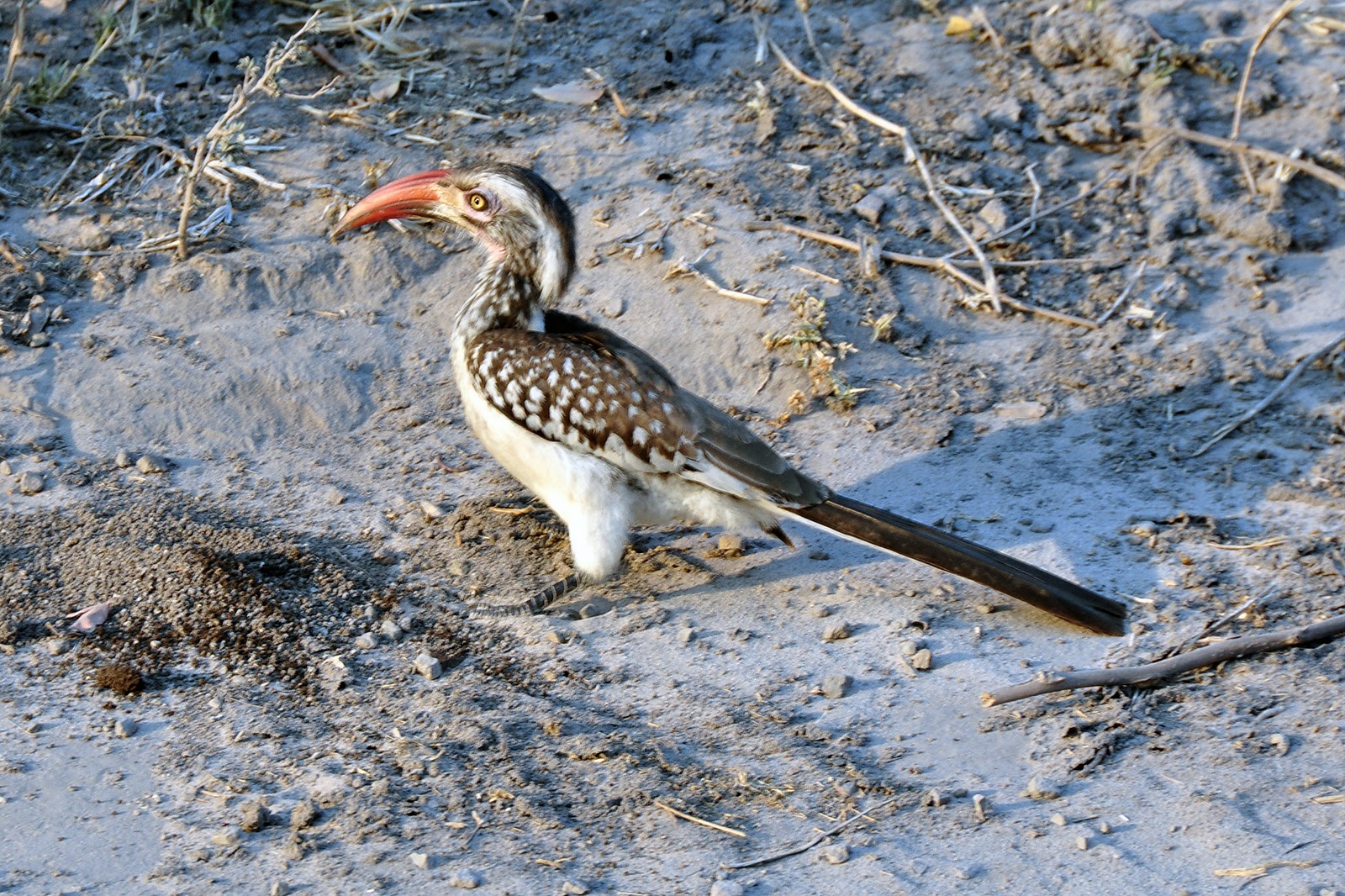
red billed hornbill

Spotted dikkop or thick knee
helmeted guinea fowl

Kori bustard

black stork

darter

African fish eagle

bee eater
squacco heron
 This is the limit of these high resolution photos that I can fit on this website. There were many more birds seen, but will have to post them another time. Let me know by email, or in comments if you would like to see more.