The Las Vegas Sun conducted an extensive investigation of the quality of care delivered by hospitals in that section of Nevada. It took two years of research by reporters Marshall Allen and Alex Richards, along with help from lots of support staff. They made use of hundreds of thousands of pieces of information. The material was presented in a multi-part series through 2010. Here is the video summary offered by Brian Greenspun, publisher and editor.
This series exemplifies the potential power of the media in focusing public attention on one of the country's major public health hazards -- being treated in a hospital. To a greater or lesser extent, a similar story could be written in most American cities. But it would take a commitment to write stories that go beyond parroting corporate press releases or believing the advertisements of self-satisfied medical institutions. Perhaps a little less coverage about the weather would free up reporters to dig through a different kind of snow job.
Congratulations to the Las Vegas Sun for showing the way.
If you cannot see the video, click here.
Thursday, February 10, 2011

Wednesday, February 9, 2011
Pauline Chen on WIHI
 A Legible Prescription for Health Care
Thursday, February 10, 2011, 2:00 PM – 3:00 PM Eastern Time
Guest: Pauline W. Chen, MD, Columnist, The New York Times; Author, Final Exam: A Surgeon’s Reflections on Mortality
Have you heard the one about the backlash to Accountable Care Organizations (ACOs)? Actually, there’s no such thing...yet. But there could be, suggests Pauline Chen in her latest “Doctor and Patient” column, if ACOs take off without fully appreciating that patients have to buy into the concept. And that won’t happen if they’re not part of the discussion and the design, and offered more than legal lingo.
Anyone interested in a bridge between patients and practitioners and health care reform has no better voice these days in a major media outlet than Dr. Pauline Chen. WIHI host Madge Kaplan is pleased to welcome Dr. Chen to the program on Feb 10 to discuss the issues she brings to light with her writing, often drawing on her own day-to-day experiences seeing patients and conversations she has with other colleagues. On this edition of WIHI, Dr. Chen wants to spend some time talking about language, especially the words doctors use with one another when describing patients; the unintended barriers created the more doctors and nurses don protective, infection-protecting garb; the mounting weight of patient satisfaction surveys; and more.
Pauline Chen says the more she delves into tough topics, the more her own habits have changed. Perhaps that’s the effect her writing has had on you, too. Come join a timely discussion with someone who often reminds us that it’s human beings who either uphold the status quo or change the dynamics in health care, no matter how many good, prescriptive ideas are out there. We look forward to your participation on this next WIHI!
To enroll, please click here.
Jubilee presents Beautiful
Here's the latest video from the Jubilee Project. As always, when you view it, a donation will be made to a charity, in this case Becky's Fund.
If you cannot see the video, click here.
If you cannot see the video, click here.
Ethical blinders?
Is this a case of ethical blinders?
Today's New York Times has an important story about the ineffectiveness of removal of lymph nodes for certain women with breast cancer. That is a significant result of clinical research. But read this:
Experts say that the new findings, combined with similar ones from earlier studies, should change medical practice for many patients. Some centers have already acted on the new information. in Manhattan changed its practice in September, because doctors knew the study results before they were published.
And they felt no need to spread the word quickly to other hospitals and to breast cancer patient advocacy groups and help women across the world avoid the surgery and its after-effects? (As noted in the article, "It can cause complications like infection and , a chronic in the arm that ranges from mild to disabling.")
La gala del nadar es saber guardar la ropa
A December article in Scientific American by Dr. Alvaro Pascual-Leone, "Get Better at Math by Disrupting Your Brain," makes some fascinating observations about brain function. It is short and worth reading. A few excerpts:
We tend to believe that our brains work as well as they can.
Being better in math does not mean being smarter at everything. But we assume that, at least within a given domain, better behavioral performance implies superior brains, because we take it for granted that the brain is working as well as it can to optimize behavior.
However, a growing number of instances in clinical neurology and a growing body of research in cognitive neuroscience reveal that this assumption is incorrect. . . . For example, if the brain optimizes behavior, disruption of normal brain activity ought to lead to a loss of function, and never to enhancement. And yet, in some instances, disruption of brain activity . . . can result in a paradoxical behavioral improvement.
Behavior after damage, or after the modulation of activity in a given brain area, reflects the capacity of the brain and its networks to adapt to the disruption. The final behavioral consequence of a brain injury may be worsened performance, but also, paradoxically, improved performance, or even recovery from the deleterious consequences of a pre-existing insult or disease.
Read the article to understand the title of this blog post!
Tuesday, February 8, 2011
Is this the image you want to portray?

 Is anybody else put off by the fact that this newsletter from the American Medical Association takes advertising from drug companies and displays it so prominently at the top of the front page and on the right side of that page, also?
Hanoi, Vietnam -- Exceeded all Expectations, Mystery Photo 4

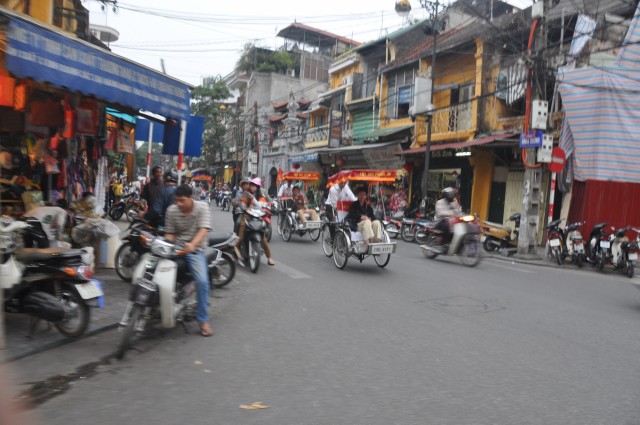
Understatement: There are a lot of scooters in Vietnam.

Above is the Ho Chi Minh Mausoleum in Hanoi, Vietnam, the subject of Mystery Photo 4
Below are two pictures of the Lenin Mausoleum in Red Square in Moscow. It is a red granite building much lower than the Hanoi building because it is backed up against the wall of the Kremlin. But the structure and style of the base is very much like that we see above in Hanoi.
 We flew from Chicago O'Hare with a short layover in Tokyo Airport, and then to Hanoi. The Mystery Photo 4 is of Ho Chi Minh Mausoleum in Ba Dinh Square in the center of Hanoi, Vietnam, where Ho read the Declaration of Independence for Vietnam,on September 2, 1945, establishing the Democratic Republic of Vietnam, then know as North Vietnam to us. The flag of Vietnam is red with a solid yellow star in the center. You see this flag hanging near the Mausoleum in the "hint" photo I provided. I wrote about visiting this Mausoleum in the December 12 posting. It was inaugurated August 29, 1975 and inspired by Lenin's Mausoleum in Moscow which we have also seen, though we did not wait in the very long line to go into that place. Here in Hanoi, there was not a real long line for some reason, so we were able to go inside. Being laid out like Ho Chi Minh is inside was totally against his wishes. He left a will that stated his wish to be cremated and have his ashes scattered in the hills of the north, central and southern Vietnam. He said he preferred cremation which is "more hygienic than burial and would also save land for agricultural purposes." But he was afterall the father of Vietnam reunification so the mausoleum is there in spite of what he wished.

Lenin's Tomb backed up against the wall of the Kremlin
One of the interesting characteristics of Vietnamese architecture is the narrowness of the houses. That is because it costs a lot to buy land fronting streets and roads, so the frontage of the houses is very narrow. But often these houses are 3 to 5 stories high and they are often painted bright colors and have very interesting decorations and styles. I have added several photos of these buildings from around the Hanoi area. Sometimes the houses look very strange because some have been built virtually by themselves in the countryside or in the suburbs standing tall and narrow all by themselves with no windows on the sides. I have
not seen this characteristic building anywhere else in the world. Even their cemeteries show this style of architecture in very small scale as you can see in the last photo.

 What the skinny houses of Vietnam are supposed to look like when put side by side.


 Water puppets for sale at a sidewalk shop.


 The water puppets in action. They are maneuvered on long sticks that are under the water. The manipulators are located behind the stage, reaching forward with the sticks.It was a ancient and very unique way to tell local folk stories.
 The cyclo.


One of the interesting characteristics of Vietnamese architecture is the narrowness of the houses. That is because it costs a lot to buy land fronting streets and roads, so the frontage of the houses is very narrow. But often these houses are 3 to 5 stories high and they are often painted bright colors and have very interesting decorations and styles. I have added several photos of these buildings from around the Hanoi area. Sometimes the houses look very strange because some have been built virtually by themselves in the countryside or in the suburbs standing tall and narrow all by themselves with no windows on the sides. I have
not seen this characteristic building anywhere else in the world. Even their cemeteries show this style of architecture in very small scale as you can see in the last photo.

One skinny house of Vietnam, out in the country.


The skinny house architecture carried over to the cemetery.


The instrumental band for the Water Puppet show.

The National Vietnamese Water Puppet Theatre and its colorful stage.



A famous bridge in Hanoi which leads to a famous Pagoda Temple. We had to get our photo taken on this bridge. Below are street scenes in the markets where Communist Vietnam practices their rampant capitalism.




Above is the entrance to what remains of the "Hanoi Hilton", the former French prison where dissidents were chained. Most of the large prison complex has been torn down and a high rise hotel tower has been built behind this remnant. Also the Vietnamese National Museum has been built on this property. Below is a view from inside the Hanoi Hilton museum. Here are seen ceramic figures representing how the French imprisoned the dissident Vietnamese during their Colonial days. There is a section which is devoted to the time that American POWs were kept here, but as you can imagine there is some degree of propagandizing here: for example referring to the American devils, etc. I guess to them we were the Devils; obviously we were the enemy. But interestingly one whole room is devoted to John McCain, showing his history, telling how he landed in the middle of the well known lake in the middle of downtown Hanoi. They have his flight suit on display. They seem to be quite proud that a man who ran for President of the United States was housed in their prison for a bunch of years.

Below is the entrance to the Vietnam National Museum.


Above is the Vietnamese National dress, the au dai for women. It consists of long flowing pants, with an overdress with a long panel in front and another long panel behind. The slim young Vietnamese women universally look gorgeous in these costumes. They are worn when the women dress up and for special occasions. And the women just mount their motor scooters with this beautiful dress.
Below is a video of Halong Bay about 2 hours north of Hanoi. These limestone hills within the Bay are known worldwide. Take a look at this video panorama of this lovely site. Above that is a combination of these rock formations that is called "Kissing Chickens." You have to take your boat around to the proper angle to "see" the chickens.

I have lots more photos from Vietnam. I think I will have to post again just to get a few more out there. As I said, there was a lot to see in this energetic young country with an ancient past.
Subscribe to:
Posts (Atom)